Booking a cosmetic procedure takes months of research. What happens in the weeks afterwards usually gets a fraction of that attention, and it is often the part that decides how smooth your result looks six months later. If your surgeon has recommended massage after liposuction, or you have seen lymphatic drainage mentioned in a recovery group and come away more confused than informed, this guide is for you.
Below you will find when it is safe to start, what a genuine post-surgical session should feel like, the habits that quietly slow healing down, and the questions worth asking before you book with anyone. Our clinic in Dee Why has been caring for bodies in recovery since 2018, so everything here comes from real treatment rooms rather than theory.
Why swelling happens after body contouring surgery
Liposuction, tummy tucks and fat transfer all disturb the soft tissue and the small lymphatic vessels that sit within it. Your body responds the way it responds to any injury, by sending fluid to the area. That fluid is what you see in the mirror at day five when you feel bigger than you did before surgery.
Compression is the first line of support. Healthdirect, the Australian government funded health service, explains that you may need to wear an elastic bandage or a compression garment for a while after liposuction, and that the swelling can take a few weeks or even several months to settle before you see the final result.
Hands-on work sits alongside that garment rather than replacing it. Gentle, rhythmic techniques encourage fluid to move towards the lymph nodes that are still working normally, which is why massage after liposuction now appears in so many surgeons’ aftercare notes rather than being treated as a luxury extra.
When can you start massage after liposuction?
Most people are cleared to begin gentle lymphatic work somewhere between three and ten days after surgery, once the incisions are closed and there is no sign of infection. Your surgeon sets that date, not your therapist and not the internet.
Some surgeons prefer to wait a full two weeks, particularly after larger volume procedures or when drains are still in place. Others want you booked in almost immediately. Both approaches are reasonable because they are based on what happened in theatre, which only your surgeon knows.
Bring your clearance to your first appointment, along with the name of your procedure and the areas treated. A good therapist will ask for all of it before laying a hand on you.
The do’s of recovery massage
The habits below make the difference between a recovery that tracks along nicely and one that stalls. None of them is complicated, and all of them are worth writing down before your surgery date arrives.
Do get your surgeon’s clearance in writing
A text message or an email is enough. It protects you, and it gives your therapist the detail needed to plan pressure, positioning and how close to work near the incisions.
Do choose someone who works with post-surgical bodies every week
Post-operative recovery is a specific skill. The therapist needs to recognise a healthy healing pattern, know what a seroma feels like under the hand, and understand when to stop and send you back to your surgeon. Experience with relaxation massage does not transfer to this work.
Do keep wearing your compression garment
Clients often ask whether the garment can come off now that the sessions have started. It cannot. The garment holds the tissue in its new position between appointments, and the two work together. Put it straight back on afterwards while the tissue is still soft.
Do book a short series rather than a single session
Fluid does not shift permanently in one visit. Massage after liposuction works cumulatively, so most recoveries respond best to a run of sessions in the first few weeks, tapering as the swelling settles. Booking the series upfront also means you are not chasing appointments while you are tired and sore.
Do speak up during your session
Pressure that feels sharp, hot, or bruising is not helping you. Say so immediately. A skilled therapist adjusts within seconds and will thank you for the feedback.
The don’ts that matter most
Don’t confuse deep tissue with lymphatic work
This is the most common and the most costly mistake. Deep pressure on freshly operated tissue can worsen bruising, increase discomfort and disturb the very areas your surgeon has just contoured. If you are unsure how the two differ, our guide to lymphatic and traditional massage explains it in plain language.
Don’t let anyone work directly over your incisions
Closed does not mean healed. Skilled work moves around the scar line and towards it as the weeks pass, never across an open or weeping wound.
Don’t assume more pain equals better results
The idea that recovery work should hurt has spread widely online, and it is wrong. Lymphatic vessels sit just beneath the skin, so the pressure needed to move fluid is genuinely light. Force pushes fluid deeper into the tissue instead of clearing it.
Don’t stop the moment you feel better
Week two often brings a noticeable drop in swelling and a rush of relief. Fluid can return if the sessions stop abruptly, and hardened areas of tissue tend to appear later rather than early. Finish the plan you agreed on.
Don’t self-treat with hard tools at home
Massage guns, wooden rollers and vigorous foam rolling belong to a much later stage of recovery, if at all. Your therapist can show you gentle self-care movements that are safe between visits.
How massage after liposuction differs from an ordinary massage
An ordinary massage aims at muscle. Recovery work aims at fluid, so almost everything about it changes. The pressure is far lighter, the rhythm is slow and repetitive, and the sequence starts away from the treated area to open the pathway before anything is moved towards it.
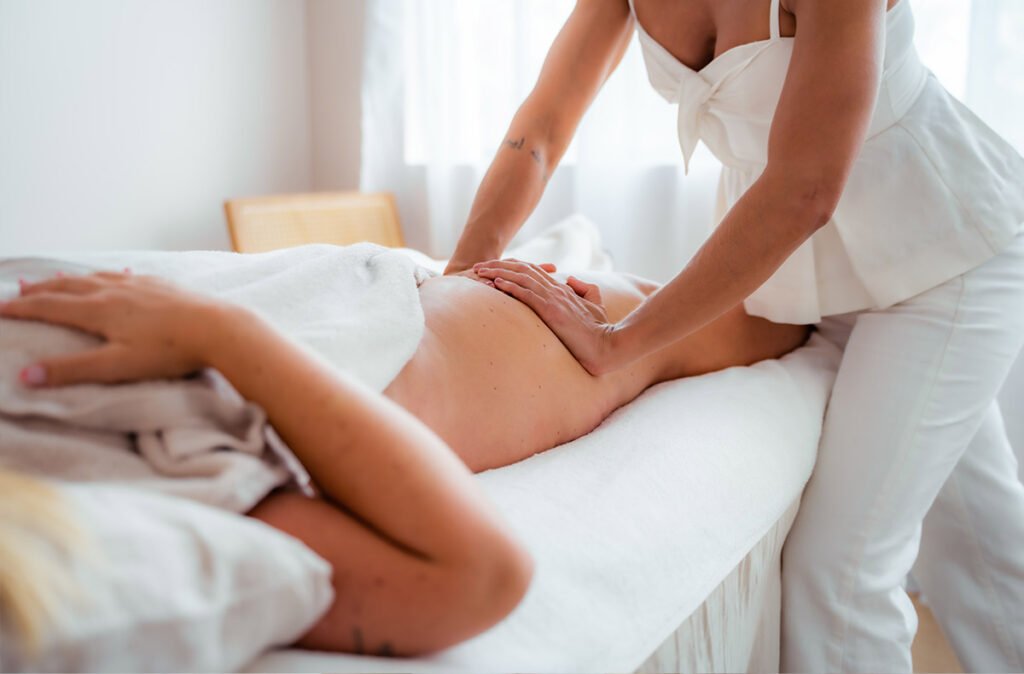
Positioning changes too. After abdominal surgery, you may spend the session side-lying and supported with cushions, and after a fat transfer to the buttocks you will not lie on your back at all.
Our Power Touch® approach combines that lymphatic sequence with sculpting techniques that support the contour your surgeon created, which is why we treat massage after liposuction as its own discipline rather than a softer version of a normal appointment. If you are curious about the method itself, the story behind Power Touch® is worth a read.
What a post-surgery session looks like at Atma Wellbeing
Your first visit begins with a conversation rather than a treatment. We go through your surgery date, the areas treated, your garment, your drains if you still have them and anything your surgeon has flagged. Nothing starts until we are both comfortable with the plan.
Saura, who founded the clinic, qualified in physiotherapy overseas and has worked with the human body since 2008, which is eighteen years of reading tissue and adjusting to what it needs. That background shapes how the whole team approaches recovery.
Sessions usually run for an hour. Many clients add LED light therapy to support the skin around the treated area, and some move on to Sculpt and Heal once the early swelling has settled and the focus shifts to shaping and comfort. Full body lymphatic drainage is another option later in the process when the whole system feels sluggish rather than one area alone.
Questions we hear most often
How many sessions do I need after liposuction?
Most people book between six and twelve sessions across the first six weeks, starting more frequently and spacing them out as the swelling reduces. Your surgery, your volume of fat removed and how your body responds all change that number, so we reassess as we go.
Does massage after liposuction hurt?
It should not. The area will feel tender, and the first minutes can be strange when you are still numb in patches, but the technique itself is light. Discomfort that lingers after a session is a sign the pressure was too strong.
Can I have this work after a tummy tuck or a BBL?
Yes, with your surgeon’s clearance and with a therapist who adjusts for the procedure. A tummy tuck changes how you can be positioned, and a fat transfer to the buttocks means no pressure at all on the grafted area for several weeks.
My surgery was three months ago. Is it too late?
Not at all. Later work focuses on softening firm areas, improving comfort and helping the tissue settle evenly. Plenty of our clients arrive months after surgery once they realise something still does not feel quite right.
Ready to plan your recovery?
If you have surgery booked, or you are already in the middle of it and feeling unsure, we would rather talk to you early. Planning your massage after liposuction before the day arrives is far easier than organising it while you are sore and swollen. Have a look at our post-surgery massage page for what is involved, check the pricing page for session and package options, or simply get in touch and tell us what is coming up. Your recovery deserves the same planning your surgery received.